A digital-archival exploration · Generative Anthropology

Beyond the Scapegoat: Roamcult and the search for a digital sacred center

Between 2019 and 2022, a community formed around a note-taking app and called itself a cult. It was unmistakably mimetic — yet it never produced a scapegoat. What did it produce instead?
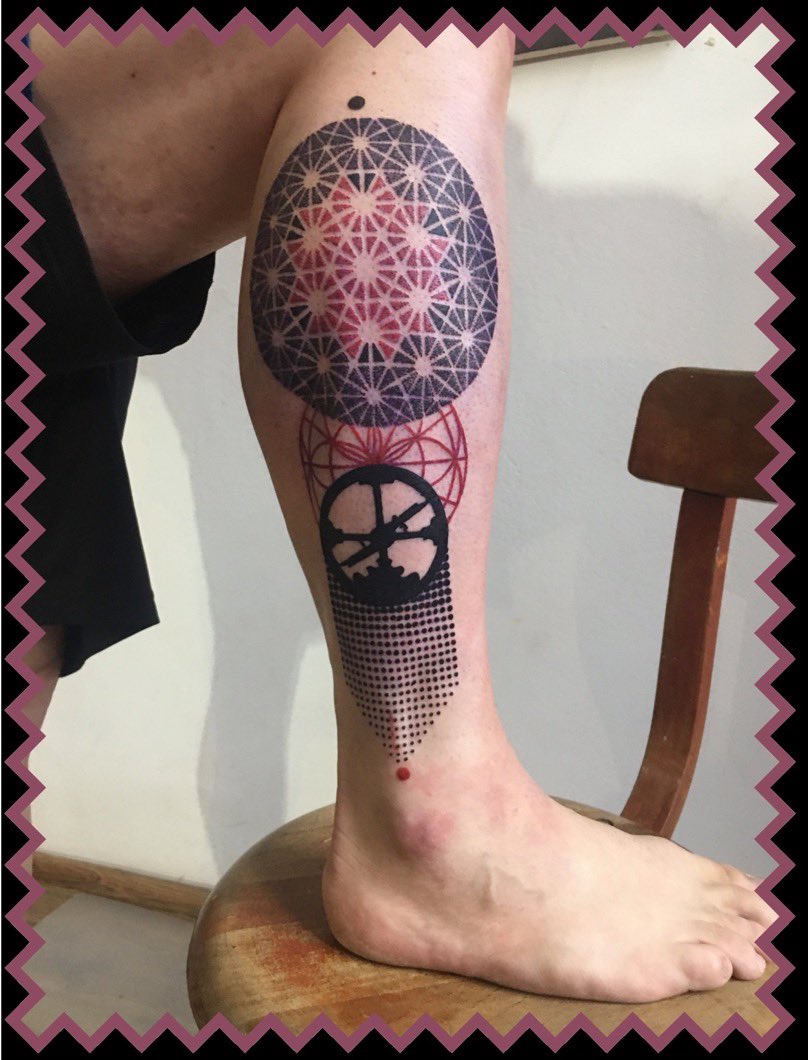
A leg tattoo: a sacred-geometry mandala above the Roam Research logo.

People tattooed a note-taking app's logo onto their bodies. A believer's leg. The founder's own father's arm. By early 2021 the count had reached five — the founder tallying each "#roamcult tattoo" as it appeared. — the most permanent sign a digital scene can leave

Follow the research on Substack ↗
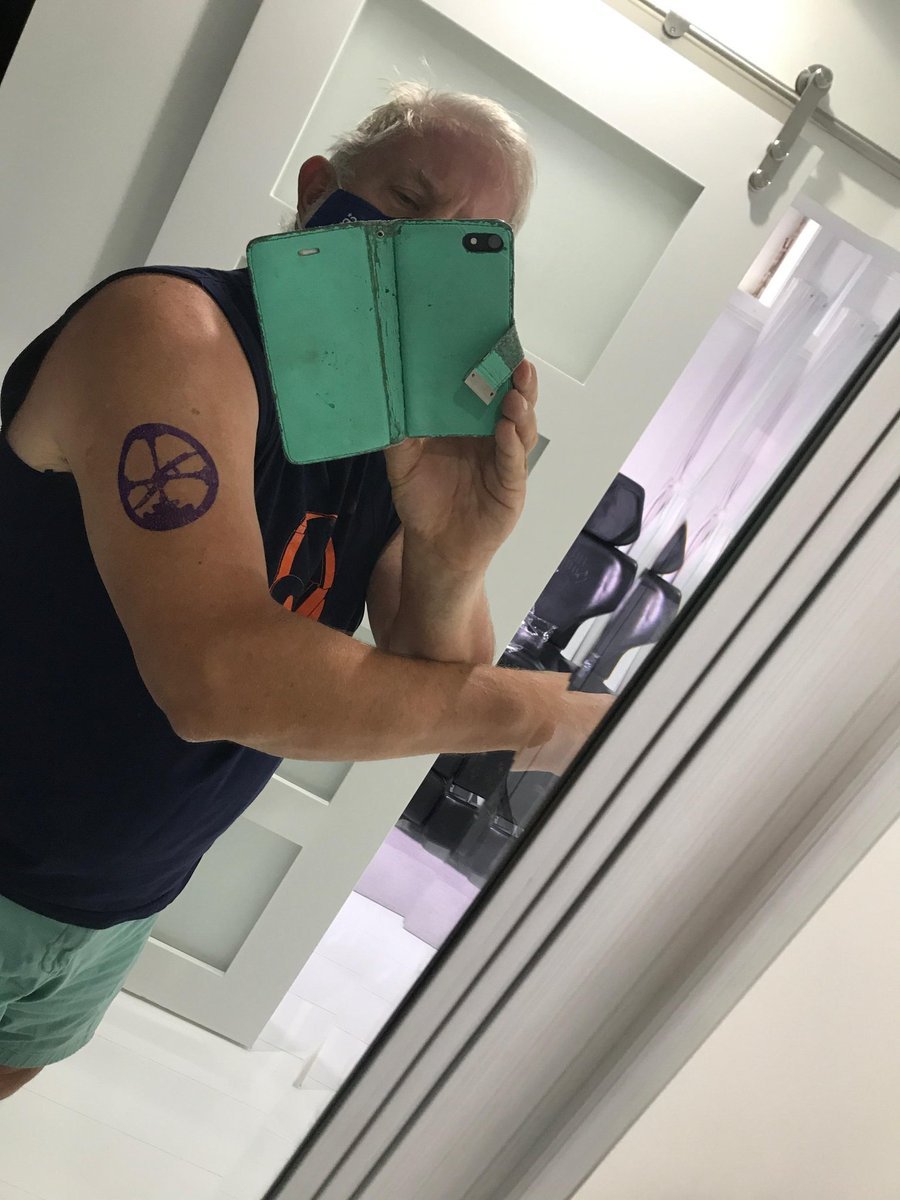
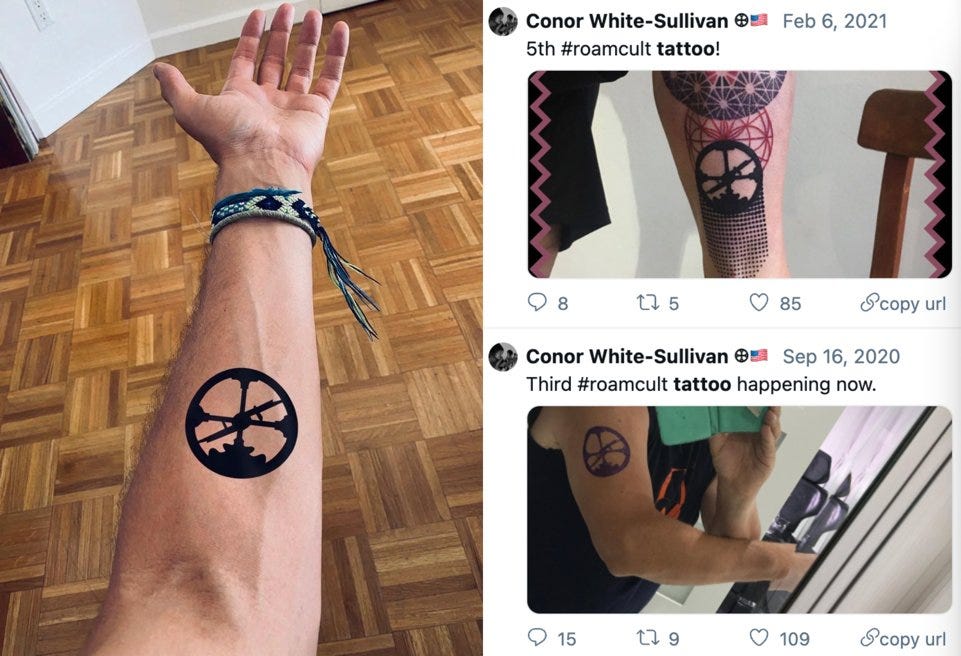
"Roam is truly making the 'second brain' meme not cliché… notes organized in the shape of thoughts… a search bar to your memory. Listen, I'm this close to getting a mariner's astrolabe tattoo. Please, you have to believe me. You can't compare it to Notion."
— @abettertake, Jan 2021 · source ↗

Photographs are public posts, reproduced for scholarly commentary with links to source. Faces of non-public individuals may warrant consent or cropping before wider publication.


What began as a user community around Roam Research rapidly took on characteristics its own members recognized as cult-like: fervent testimonials of cognitive transformation, evangelical recruitment, tattoos of the logo, public sharing of personal knowledge graphs, and a tiered [[Believer]] membership that formed an inner circle around the product's development. The intensity peaked as pandemic lockdowns drove social life online. By 2022, the fervor had largely dissipated.

This is a hypothesis-generating account, not a completed ethnography. It draws on public Twitter/X discourse, community traces, and the researcher's own participation during the period of greatest intensity. It asks whether Roamcult can be understood as a case of scenic formation — and whether Eric Gans's originary thinking can clarify what René Girard's scapegoat mechanism alone does not.

The Girardian entry point

Roamcult was clearly mimetic. Participants did not arrive at enthusiasm through isolated evaluation of features; they encountered others' visible desire and were drawn into it. Scrolling Twitter, prospective users saw life-changing testimonials, shared workflows, screenshots of personal graphs. They desired not merely a useful tool but the clarity, belonging, and identity others appeared to have found. Desire spread through contagion.

The gap Girard leaves open

Yet Roamcult did not culminate in sacrificial crisis. The community generated collective energy without being organized by destructive rivalry. Participants outdid one another in helpfulness — tutorials, public thinking, plugin development, zeal. One participant's phrase captures it:

"friendly ambitious nerds"
— a Roamcult participant, on the community's competitive generosity

Toward Gans: desire organized around a center

If Girard explains the contagion of desire, Gans may explain how that desire was organized around a shared center. In the originary hypothesis, the group constitutes itself through shared reference to a center of attention that both intensifies and regulates desire. Here, Roam-as-represented functioned as such a center — not simply software, but a shared object of transformation around which participants organized practices, identities, and mutual recognition. The technical substrate (bidirectional links, block references, daily notes, graph structures) was real; but the center was constituted by collective representation: the claim that Roam changed how one thought.

Irony hardening into sincerity

The tongue-in-cheek self-identification as a "cult" may have intensified this scenic formation. The ironic framing licensed forms of fervor that might otherwise have felt excessive — participants could perform zeal while staying in on the joke. But observers could read those performances as earnest, and public signs of devotion fuelled further imitation. What began as irony may have accumulated into sincerity.

A trajectory in scenic terms

Formation

The center emerges

Mimetic desire is drawn into a common field of attention organized around Roam-as-represented.

Peak

Scenic coherence

Participants orient toward the same center with escalating intensity, held in productive tension by shared signs and recognition.

Decline

The charge fades

Obsidian and Logseq draw attention elsewhere; pandemic conditions ease; the company's public energy diminishes. The scene dissipates — without a scapegoat.

Roamcult is offered as a pilot case for digital scenic formation. Platforms make others' desires continuously visible, accelerating contagion but also making scenes fragile: attention gathers quickly around a center, and migrates quickly when the center loses charge.

EDITORIAL NOTE (Aria) — This section condenses Kahlil's GASC proposal in his argument's terms; it is faithful to the proposal text rather than newly invented. Treat all copy here as a draft to revise in your own voice. Quotes attributed to participants are drawn from the proposal and should be verified against source tweets before publication.

Questions brought to the conference

— Is "sacred center" the right Generative Anthropology concept for Roam-as-collectively-represented?

— How might one distinguish mimetic contagion from scenic formation using public digital archives?

— What interviews, artifacts, or comparative cases would turn this pilot into a fuller ethnographic project?
The archive · 2019–2022

The Data

A corpus of public Twitter/X posts about Roam Research and #roamcult, collected by keyword and by account, deduplicated into a single archive. Below: the patterns the argument rests on, and the full archive to browse yourself. The traces show how enthusiasm, identity, and shared attention became publicly legible — not the private experience behind them.

Patterns
Browse the archive
The rise and decline of #roamcult
Monthly volume of #roamcult discourse. The shape of the scene: a long formation, a sharp peak, a slow dissipation.
Attention migrates to competing tools
As #roamcult volume falls through 2021–22, mentions of Obsidian, Logseq, and Notion climb — the center losing its charge. Toggle series in the legend.
The circulation of key terms
Monthly frequency of the community's vocabulary. Toggle terms to compare their lifecycles.
A center, not a leader
Most-mentioned handles. @RoamResearch — the product itself, as collectively represented — sits at the center by an order of magnitude, ringed by a field of micro-models rather than a single charismatic head.
Competition as contribution
Markers of generosity in the corpus — the empirical face of "friendly ambitious nerds." Outdoing one another took the form of helping, sharing, and building.

Qualitative readings

Up Close

Counts show the shape of the scene; specimens show its texture. Below: individual posts read closely against the argument, and moments where one person's visible desire was re-broadcast by others — mimetic circulation caught in the act.

Specimens
Circulation

A quote tweet is desire with a signature on it: re-sharing what someone else made visible, plus one's own endorsement. These are reconstructed from quote links preserved in the archive.

Tongue-in-cheek, and not

The bit gets real

Roamcult performed its own cult — half as a joke, half in earnest. That doubleness isn't a sideshow to the argument; it is the argument. The community supplied the religious vocabulary itself, then meme-ified its own devotion. Here's the bit as the archive caught it — and the turn that community memory says ended it.

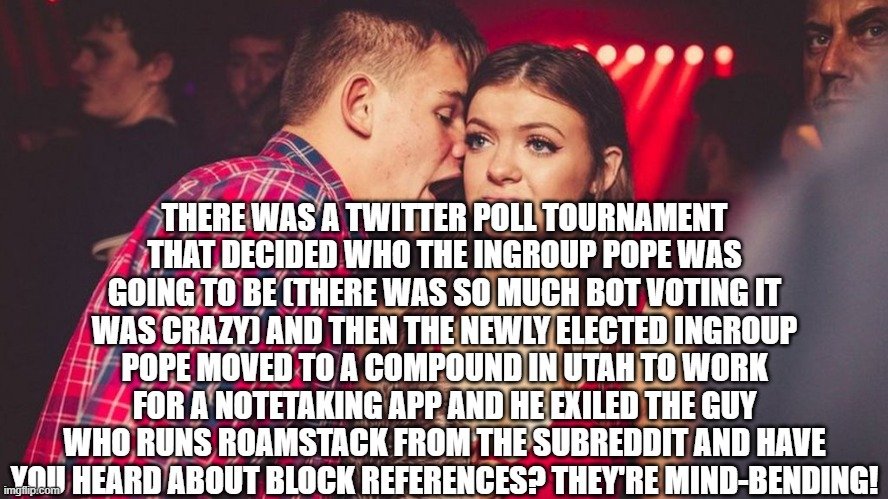
A meme compressing Roamcult's in-group lore into a joke about poll tournaments, an 'ingroup pope', and a compound in Utah.
A member compressing the lore into a joke (@uberstuber, Oct 2021). Read it as a specimen of how Roamcult represented itself to itself — satire, not a literal record. source ↗

The bit, as the archive caught it

None of this is outside commentary — it's the community doing the bit on itself, in earnest enough to be felt and ironic enough to be deniable.

"The sacred creed of #roamcult."
@RoamResearch · Apr 2020
A literal "Roamcult Mass" on Clubhouse — the founder later thanking those who "shared prayers from different faiths" to close it: LDS, Sikh, Buddhist, Christian.
@Conaw · Jan 2021
"#roamcult completely out of control. Bunch of lawless heretics." Dissent gets framed as a "1517 religious schism."
@Conaw · 2020
A believer announcing a move "to a compound in southern Utah run by a note-taking app."
@webdevMason · Dec 2020 · 536 likes
#RoamGames — a community competition with entries and voting, explained by the founder himself when newcomers were confused.
across #roamcult · early 2021

The turn

Every bit has a turn.

By participants' own telling, the late phase pointed the irony back at the center. A half-joking, half-serious move — the "roaminati" — turned on the founder himself, and former Believers drifted off to Obsidian and Logseq. The drift is visible in the data; the story behind it lives in community memory, not the public archive — the kind of thread the interviews exist to follow.

EDITORIAL NOTE (Aria) — This is the section's analytical hinge, and it cuts deeper than it looks. If the turn was against the founder, who was fused with the sacred center, then Roamcult may not be a case of "no scapegoat" (as the proposal currently has it) but of a scapegoating that misfired: targeting the center did not re-cohere the group in the Girardian way — it desacralized the center and the scene dissipated. That is arguably a stronger resolution of the Girard–Gans question than "no scapegoat at all." But it is participant memory, not documented data, it names a real person, and it runs ahead of the submitted GASC abstract. Treat it as a hypothesis to substantiate, not a finding — and decide deliberately whether the public site should lead the paper here.

How the archive was made — and its limits

Methodology

The argument above is interpretive; this page documents the evidence honestly, including where it is incomplete or noisy. Transparency about the archive is part of the method.

Collection

Public posts from X (Twitter) spanning were collected along two paths. A keyword path searched hashtags and Boolean queries (e.g. #roamcult, (roam OR roamcult) (template OR workflow OR graph …), and a query targeting the "Believer" pricing tier). An account path scraped the Roam-related posts of the founder, the official account, the self-styled cult account, and a set of active community members. The two were merged and deduplicated into one master archive of unique tweets.

Cleaning & quality

The merge is clean: every tweet has a unique identifier, with no duplicates and no missing core fields, and dates and links are well-formed. The known weakness is the keyword path. Because "roam" is an ordinary English word and "believer" an ordinary phrase, the broad Boolean queries — the "Believer" query especially — pulled in false positives: VR-gaming "free-roam" promotions, "true believer" political and religious posts, a Metallica lyric, and similar noise. A conservative filter flags the clearest of these as off-topic; they are hidden in the browser by default and excluded from the charts. Borderline "Believer" cases remain and should be hand-checked before any quantitative claim about that term.

DATA-QUALITY FLAG (Aria) — "Believer" is both a key concept in the argument and the most contaminated term in the archive. Before citing any count of "Believer" language, isolate genuine Believer-tier discourse by hand; the raw frequency is not yet safe to publish.

A tension the data surfaces

The proposal locates peak intensity in "the early months of the COVID-19 pandemic." The #roamcult volume curve instead peaks in December 2020 – February 2021, roughly a year into the pandemic. The honest reading distinguishes onset (early-pandemic conditions seeding formation in 2020) from peak intensity (early 2021) — and the lag is itself interesting: scenic coherence took months of accumulating visible desire to crystallize.

EDITORIAL NOTE (Aria) — The peak-timing observation and the contamination assessment are Aria's findings from auditing the dataset, offered for Kahlil to weigh, not claims he has made.

What these traces can and cannot do

Public archives can establish the shape of the phenomenon — its arc, its center of attention, the migration of interest. They cannot, on their own, adjudicate "mimetic contagion" versus "scenic formation," since both predict similar surface traces; that distinction is theoretical, turning on the kind of organization rather than on counts. Nor can tweets reveal private experience. The archive marks the field of visible desire and its center; whether that center is a Gansian sacred center is the question brought to the conference, not a result claimed from the data.

Known limits

— Early years (2019–2020) are likely incomplete.

— Deleted and protected tweets are not included (survivorship bias toward what persisted publicly).

— Engagement counts reflect values visible at collection time.

— This is one platform; Roamcult lived across Slack, the forum, Reddit, and YouTube as well.

— The scrape did not capture reply linkage (parent-tweet IDs are absent and conversation_id is a stub), so reply-thread reconstruction is not possible; quote-tweet relationships were preserved and are used instead. A future scrape capturing in_reply_to_status_id would enable thread-level analysis.

The presentation

The Talk

The GASC slide deck and the recorded presentation. (Embeds are wired up — drop in your URLs and they appear here.)

Slides

GASC Presentation Deck

[[ deck ]]
Paste a Google Slides / Canva / SlideShare embed URL into CONFIG.deckEmbedUrl at the top of this file's script, or a published-PDF link. It will render right here.
Video

Recorded Presentation

[[ video ]]
Paste a YouTube or Vimeo URL (watch or embed form) into CONFIG.videoUrl. It will convert to an embed automatically once the recording exists.

Get in touch

Contact

If you were part of Roamcult, or you're working on something adjacent, I'd like to hear from you. Reach me directly, or follow the research as it develops.

sugbu@corazo.org

Kahlil Corazo · Department of Anthropology, Ateneo de Davao University.

roamcultresearch.substack.com ↗

The form uses Netlify's built-in handling — submissions appear in your Netlify dashboard under Forms, no backend needed. It activates automatically once the site is deployed on Netlify.